Unconventional Career Idea 💡 Try the *New* Affiliate Marketing
I independently review everything I recommend. When you buy through links on this site, I may earn a commission at no cost to you.
In the internet world, there are two words that have gotten a bad rap:
Affiliate.
Marketing.
BUT HANG ON, I HAVE THINGS TO SAY. (And, it’s good!)
First, a primer on how the internet works:
- We look things up.
- We read recommendations.
- We buy stuff based on those recommendations.
Right?
That’s *the internet*, right there. It’s how we use it every single day. Think about the last time you went on vacation (and needed to know where to stay). Think about the last time you bought a garden hose (and needed to know which brand). Think about the last time you wanted Thai (and needed to pick a restaurant).
The internet is one big directory of information. ( ✅ Good.)
But because there is so much information out there, it’s really hard to determine what’s quality information. (❌ Bad.)
So, what do we all do to combat this???
We turn to the people and brands we like and trust and follow obsessively to tell us WHAT THE HELL TO BUY.
You have a brand like that, right? Like, I read every email The Spruce sends. Everything they publish seems to be exactly what I need to know right in that very minute, like which freaking garden hose to buy. Bought the Zero G they recommended & used it to pressure wash the house the other day like a total creep and it worked like a dream.
That’s because that’s all they do: home & garden product testing. They are doing the work of sorting through the mess, so when I need a new garden hose, I don’t have to wonder if that $199 olive-colored garden hose from Pottery Barn would actually…work.
You know what I mean? It’s way too overwhelming, and way too time-consuming, to personally sort through everything out there and try to make an informed decision (particularly when one article says this, but another one says the exact opposite).
We need filters.
Filters make our lives better.
This is the job of curation: and, it’s a modern career.
You know what it actually reminds me of? The publishing industry. Big five publishers don’t accept unsolicited manuscripts from random writers off the streets; first, you’ve got to get signed by a literary agent to represent you. Once you do that, the literary agent can approach publishers with your book.
Literary agents are filters.
They exist to curate books. Because publishers know that if an author has gotten past them as gatekeeper, the manuscript is worth reading.
There is tangible commercial value in curation.
Which means something very important:
If you can become “the literary agent” of your industry, so to speak, and if you can curate the best of the best in your industry—just like a literary agent would—then people around the world will start to look to you for your opinion.
You become their filter.
You save them time, money, energy, bad experiences, bad purchases, trial and error.
They trust your recommendations, because you are THE go-to source on EVERYTHING X.
And this, by the way, isn’t just an affiliate marketing lesson: it’s also a lesson in how to become known as an expert in your field: you do the labor and report on it.
Okay, with me so far?
Great. Grand. Magnificent!
So now, what happens when you become a go-to source in your field on EVERYTHING X???
You have attention.
The people who are the biggest die hard fans of EVERYTHING X are following you. Watching you. Reading you. Listening to you.
In this way, you’re simultaneously curating an audience.
And, you know what an audience is???
A product in and of itself.
Because you know who pays for access to that audience?
Brands who need to reach that audience.
Imagine if you started a cool new paint company, and you needed customers who love paint. You’d immediately start figuring out who already has access to those customers.
Where are the customers hanging out?
Who are they reading?
Who are they listening to?
Who are they following?
And then, you’d do a deal with that person or brand in order to help you advertise your product.
Right???
This isn’t anything novel; it’s how the commercial world works, and always has worked.
In the past, we did this with television: brands would pay networks to insert ads into their programming. Children’s products would get ads on cartoon networks; adult products would get ads on prime time TV; sports-related products would get ads on sports channels—and so on.
But then, something happened: the internet changed everything.
It democratized attention.
Now, you don’t have to be a big multimillion-dollar television station in order to command attention and attract an audience; you can be a dude in your bedroom.
And, brands want to work with the dude in the bedroom because the dude in the bedroom is who people are actually listening to.
Especially when it comes to EVERYTHING X.
Which means this:
If you can become the dude in the bedroom that everyone’s paying attention to?
Brands will give you money to get in on a piece of the pie.
There are two ways this happens:
- Sponsorships, where a brand pays a flat fee to advertise in your publication.
- Affiliate partnerships, where a brand gives you a tracking link to their product, and you make a commission for every sale made through your link.
We’re not talking about sponsorships today—though we will in the future! Today, we’re talking specifically about affiliate partnerships. Because the two are not the same. :)
Affiliate partnerships are actually awesome: a brand only pays if you sell their product. And on the same token, the more you sell, the more you get paid.
Contrast that with a flat fee for an ad in your newsletter, for example, where you might sell $100,000 worth of product and only get compensated $500.
On the other hand, if you have an affiliate tracking link from the company, and you move $100,000 of product?
You might make a $50,000 commission.
HUGE DIFFERENCE. 🧨
That’s based on a 50% commission structure, which isn’t unusual at all—depending on which kind of affiliate link you have. (More on this in the advanced deep dive below.)
Another popular commission structure is 30% and 20%, which still puts you at a sweet $30,000 or $20,000 earned, just for helping to sell a product you already love.
The percentage offered is at the discretion of the company, of course, but typically the more profit margin they have, the bigger the commission they can afford to offer.
Usually, this is a one-time commission, but in some cases there are also recurring commissions, where you get paid a percentage for every month that customer pays them. This is usually the case for SaaS companies (software as a service) where customers pay monthly.
So, why the bad rap?
Because it can seem disingenuous if it’s not done right.
Picture an influencer you follow, suddenly hawking some sort of weird product. I chose the word “hawking” deliberately, because that’s what it can feel like…when the person doing the selling either (a) isn’t good at selling, or (b) isn’t doing so ethically. There’s this sense that you, as an audience member, are just being used to sell products to. And, that feels icky.
But, the problem isn’t that affiliate marketing is bad; it’s that there are bad affiliates.
Affiliate marketing, on its face, is a great advertising & sales strategy—especially if there’s a real product/market fit, and you’re doing the labor to curate for your audience.
Back to The Spruce.
They’re a review site for home & garden products, right? They curate the best of the best, for this particular audience.
Well, lovely as it would be to do that completely pro bono, as a team of good samaritans, that’s not how the world works.
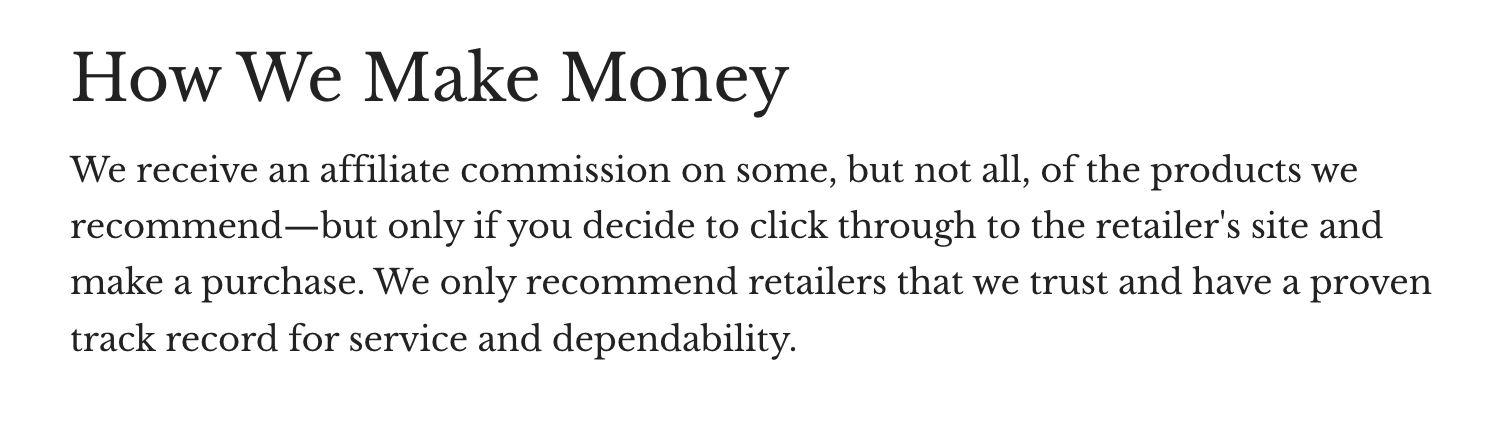
Instead, here’s what they say under their commerce page:
Ta da!
So, as you can see:
- They curate products
- For a specific audience
- And then when that audience buys something they’ve recommended
- They earn a commission
The way they do that is with affiliate tracking links, that can track purchases made through their site.
And, what a lovely + fun business model!
They’re providing a service (curation), and in return, they get compensated for helping the right people find the right products.
You could do this with *anything*:
- A review site for EVERYTHING CATS.
- A review site for EVERYTHING BASEBALL.
- A review site for EVERYTHING JEWELRY.
Do you know how hard it is to find fun baubles anymore?! That aren’t cheaply made? But don’t cost $3,000 a necklace?
Finding them is a modern career.
That is the art of curation.
Of course, however, there’s a right way to do affiliate marketing, and a wrong way.
Do it the right way, and it’s more than possible to make a full-time income of $100K+. (I bring at least this in every year as an affiliate, and so do my colleagues.)
Do it the wrong way, however, and you’re going to find yourself in THE AMAZON LAND OF DOOM—or what I refer to it when people first learn about affiliate marketing and automatically sign up to partner with Amazon with 2% commission rates and then never drive any traffic or make any money and throw their hands up in despair.
It doesn’t have to be that way.
You can create an awesome new career as an affiliate partner—so long as you know how.
Next Up: The Contemporary Affiliate Marketing Deep Dive
Career Title:
Online Publisher
Career Overview:
Curate the best of the best in your industry, and receive compensation for sending your audience to products you love.
How It Works:
You apply to be a partner with the companies who make the products you love. Sometimes, access is open to all. Sometimes, they will have to approve you first. Approval is based on one big thing: Do you have a relevant platform with the right target audience? This means that you’ll want to get started first, so you can establish your identity online. (And show potential affiliate partners that you’re a perfect fit, and will attract the right customers!)
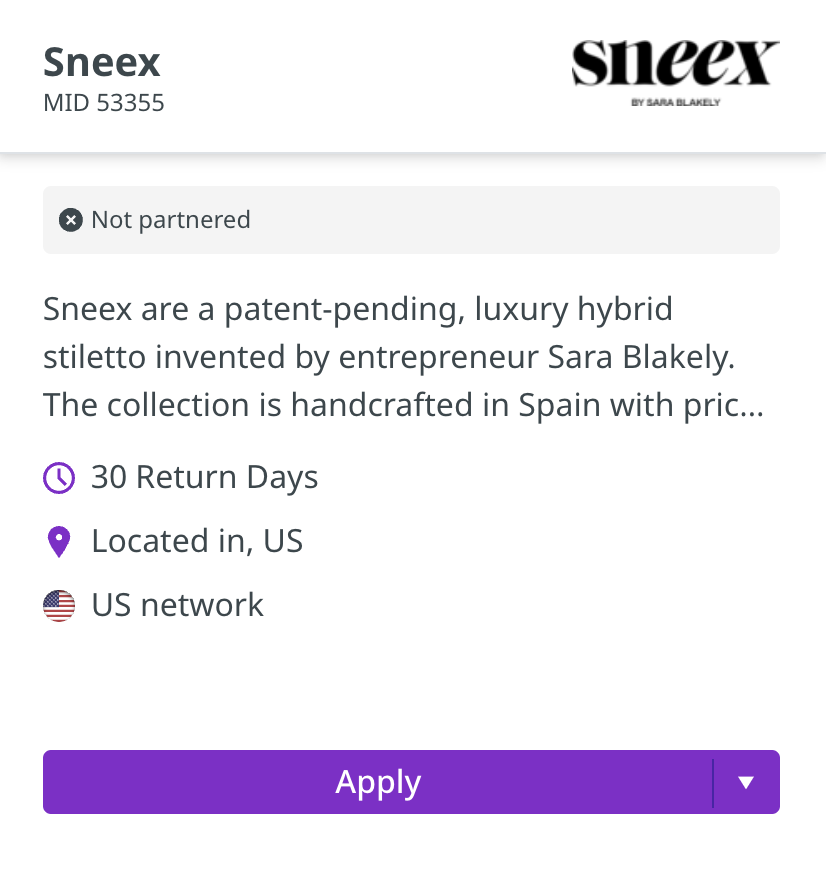
There are also affiliate marketplaces where you can sign up as an affiliate, fill out your profile, and then be able to view and apply to ALLLLLLL the different affiliate programs in one place. The most popular ones include:
Rakuten (don’t be put off by the stupid name)
And then, of course, there’s a fan favorite:
Amazon’s affiliate program is one of the biggest around the world. (As you might expect.)
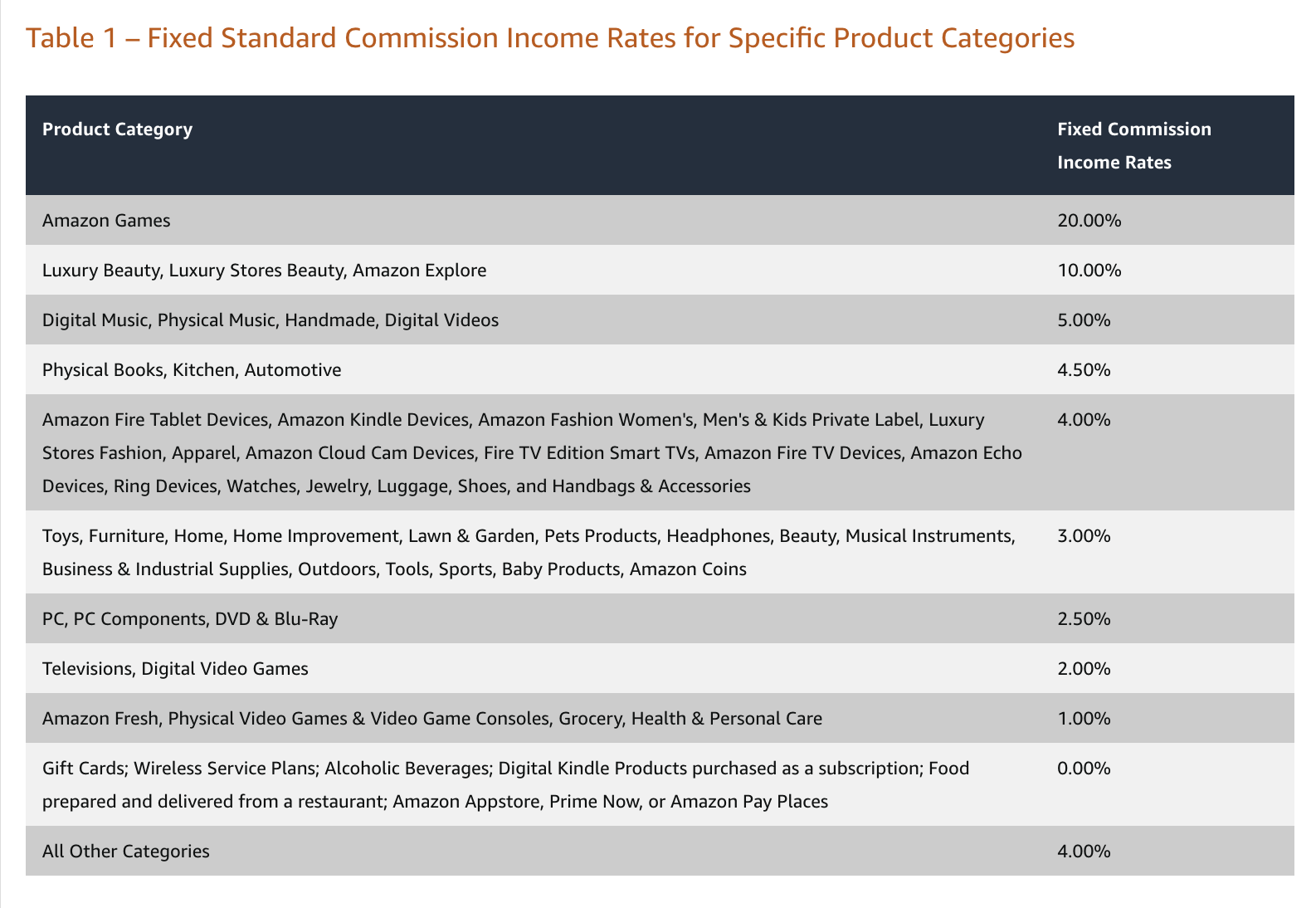
The commission at Amazon range greatly, depending on price point. (For example, you’ll only earn 2% if you sell a television, but since the average cost of a TV is pretty high, it still makes sense.)
Here are their current commission rates:
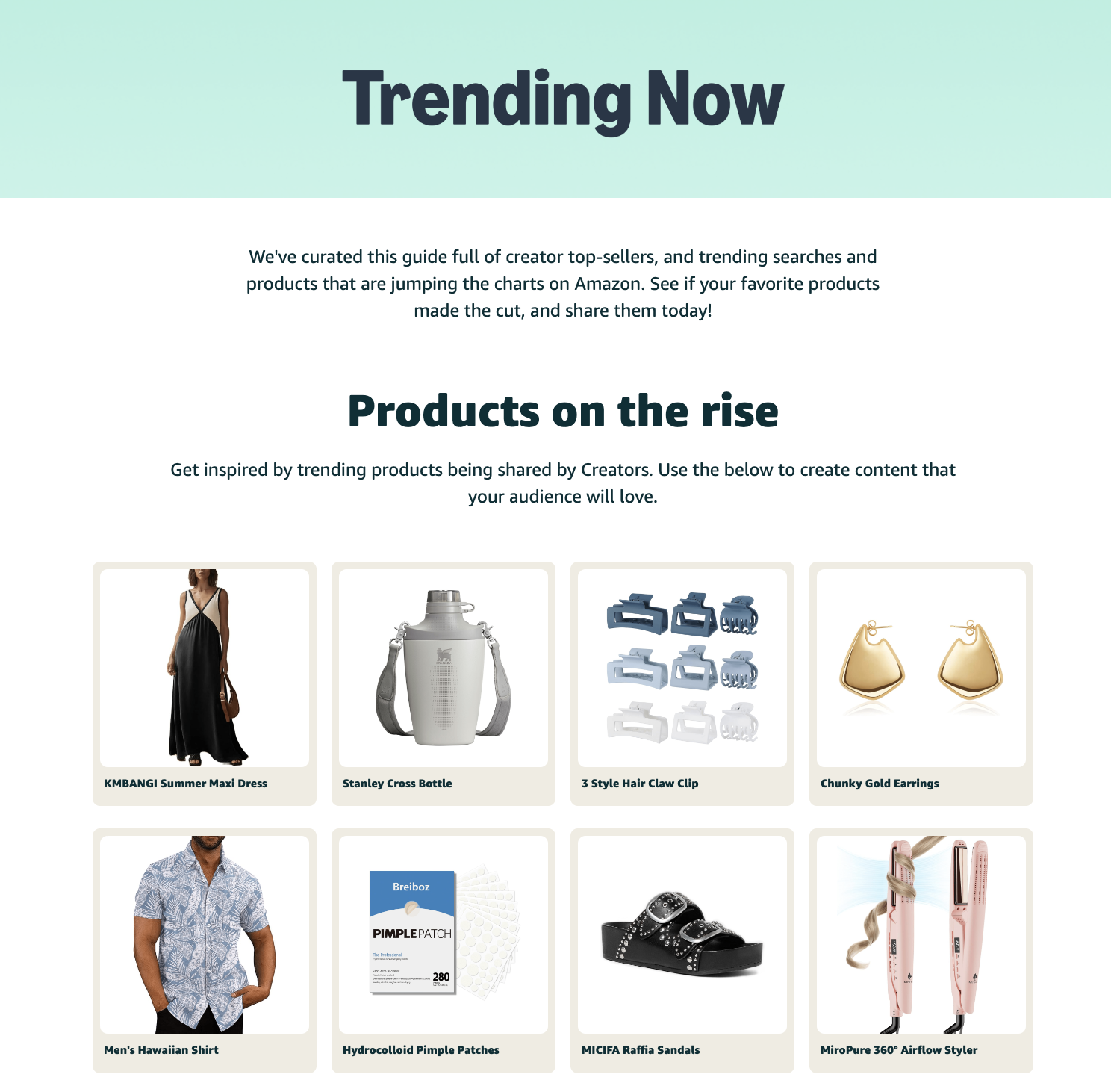
And, they’re always doing creative things like showing you what’s trending right now, so you can promote it.
(Of course, this works best if you have the kind of site where you *would* be promoting physical products!)
NOW, for the important stuff.
While that’s all well and good, you know where you’re going to have the most success with affiliate marketing?
Not with physical products, but with digital ones. (This is my wheelhouse.)
Digital products include things like online courses and online memberships and online software.
And, guess what?
Oftentimes, the best, most generous and well-run affiliate programs are run by individuals, not companies.
One of the best-run programs out there:
Amy Porterfield offers a generous, industry-standard 50% affiliate commission on her signature online training program, Digital Course Academy. That’s because online programs are delivered digitally and are scalable, so the commission can be higher.
Here’s what that looks like behind the scenes (from the current literature):
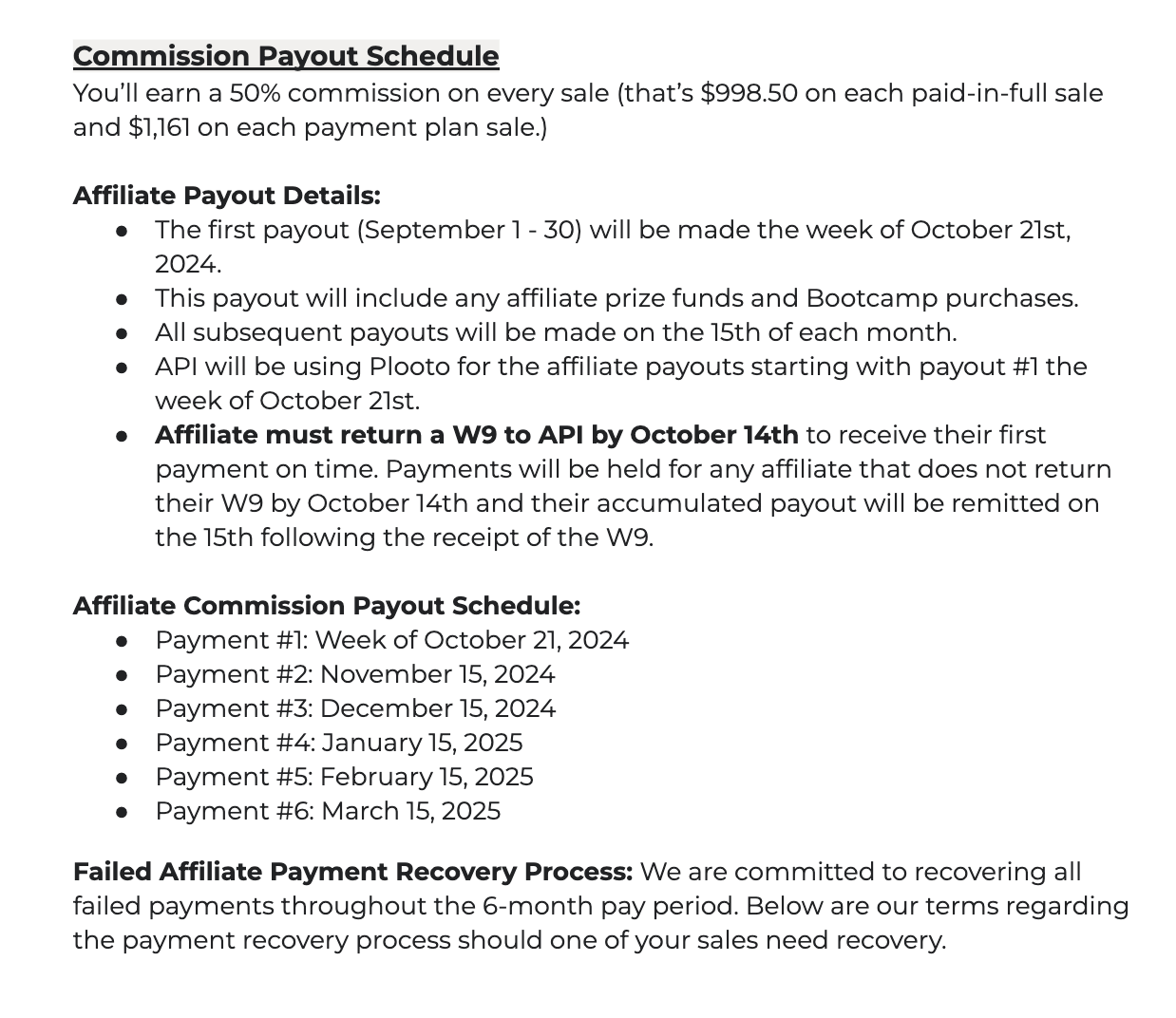
That’s a $998.50 commission on each paid-in-full sale, and $1,161 on each payment plan sale.
Essentially, what Amy is paying for is advertising. Affiliates are fantastic advertisers, because they must tell their audiences about your product in order to spread the word.
But, it’s not just advertising.
She is also paying for something very, very, very valuable:
List building.
You’re always wondering how to build your email list, right? It’s *always* a topic in the online business world. And guess what?
Creating an affiliate program for your products and courses is one of the best ways to do it.
For example, Amy gives her affiliates lots of different resources to share with their audience to get them excited about the topic of online courses…before the program launches.
Here are three current examples (my own affiliate links!):
- This free downloadable guide containing 10 case studies of how people make money with online courses
- This free 2-minute quiz that will help you decide if you’re sitting on serious digital course potential
- This free downloadable guide containing surprisingly simple ways to turn your knowledge into an online course
Notice one thing each has in common?
An email opt-in.
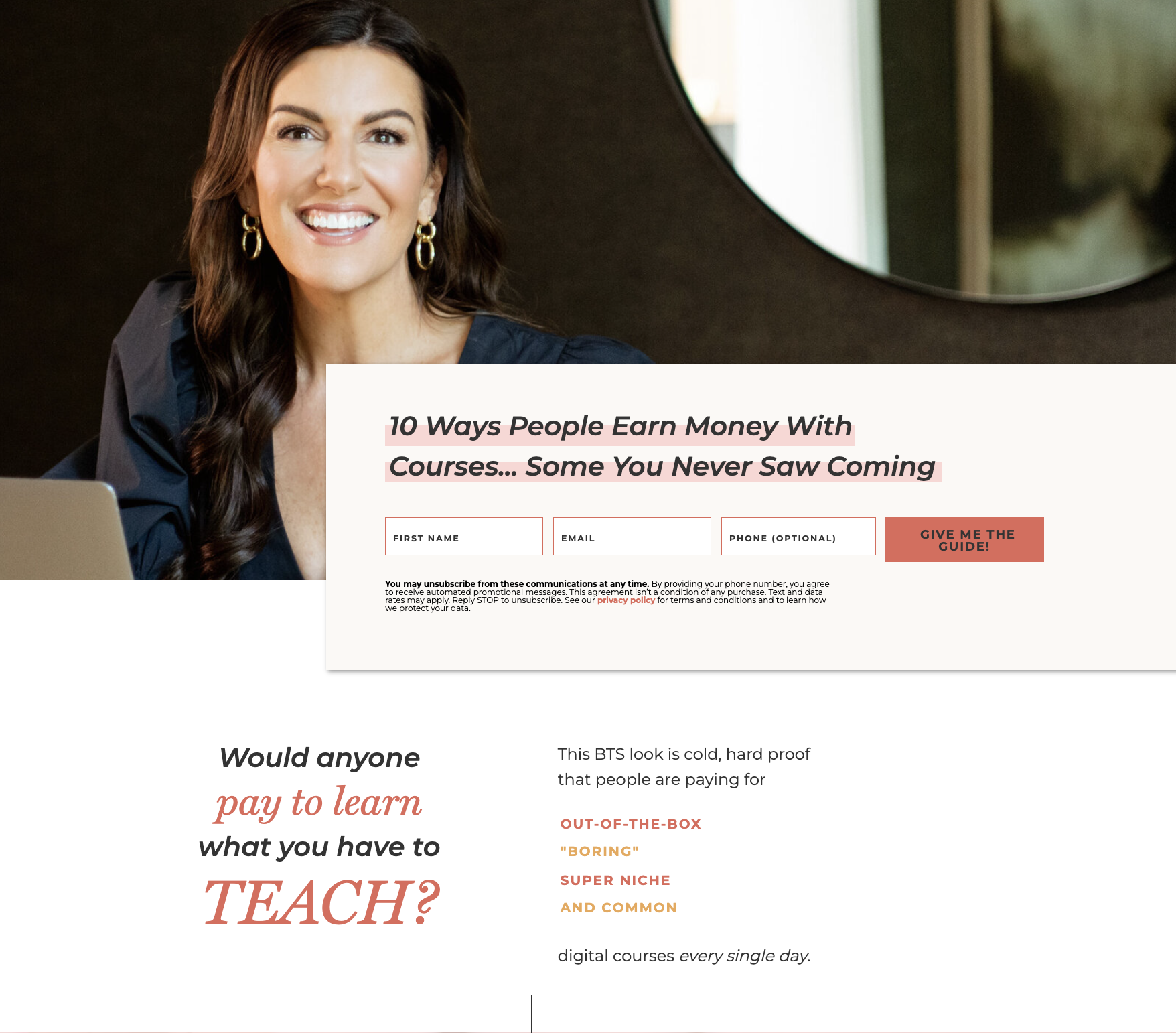
Therefore, any time I send Amy a lead, they’ve got to opt-in to get the information. Firstly, this makes sure they’re only getting the info they want (and aren’t being spammed), but secondly, this ensures that Amy can hang onto those leads and tell them more about Digital Course Academy.
She has built a giant email list this way.
Furthermore, each one of those resources also contains an affiliate tracking link, so if an affiliate shares one of these with their audience, they will still get credit for any future sale.
It’s not credit for ANY sale in the future forevermore, but as long as the program allows. This is determined by something called “cookies.” Each program can set their cookie duration.

So, it’s a win/win for everyone: your customers can get hooked up with some of the best people out there, you can get compensated for making those connections, and the creators can get new customers.
Here are some other favorite brands with awesome affiliate programs:
- Marie Forleo ($1,000 per sale)
- Susie Moore ($250 per sale)
- Lindy Alexander’s Travel Writing Course
- Bench Accounting (~$500/sale, varies)
- Tonic Website Templates ($225/sale, 15% of sales)
- Circle ($120 per sale)
- Shopify ($150 per sale)
- Beehiiv (50% recurring commission for 12 months)
- ConvertKit (30% recurring commission for 24 months)
- Active Campaign (30% recurring commission)
- Teachable (30% commission for 12 months)
- Deadline Funnel (33% recurring)
- Lead Pages (50% recurring)
- Demio Webinars ($100/sale)
- Squarespace ($200/sale)
- Go Live Squarespace Templates (20% commission)
- Bluehost (70% per sale, capped at $100 per sale)
- Hypefury (25% commission)
- Typeshare (30% commission)
- Safety Wing (10% commission)
- Elevae Visuals (30% recurring)
- Bonjoro (30% recurring for life)
- Crowdcast (25% recurring for 3 years)
- Skillshare (40% commission, up to $67 per sale)
^Some of these are my own affiliate links, and some I’m not an affiliate for, but respect greatly.
And that’s just a handful!
Companies have really embraced creators and the value of their recommendations, so this is a VERY fun way to earn a living while connecting people to the things you love.
So, step one: turn to the people you follow and love, and see if THEIR work has an affiliate program. 💥
(I’m actually in the process of rebooting my own affiliate program for my online courses—keep your eyes peeled!)
Like I said before, it really benefits you if you’re passionate about what you do, and you’re becoming known for it, because you’ll become *the* go-to person for EVERYTHING X.
How to Get Started:
- Start a newsletter around EVERYTHING X. You *need* the ability to email your audience—social media will not cut it for this.
- You can, however, use social media to drive traffic to your newsletter. I would 100% make sure every link in your socials takes people *to your newsletter sign up* (and not to your affiliate link). This is because most people do not randomly make purchases, so the odds of them clicking that and buying right away are slim. You need a way to continue expressing your enthusiasm for a product over time, and that has to happen via email.
- There are three ways you can run this: (a) Start a newsletter like The Skimm and include affiliate links throughout each email (best for low price points); (b) Start a regular newsletter and then periodically send out one big, bold, exclusive email with an affiliate product (best for medium price points); (c) Start a regular newsletter and then halt all operations and go into full launch mode for ~2 weeks, helping to promote an affiliate partner (best for high price points). Or, you can do a combination of all three! That would be my recommendation. The affiliate programs that come with $1,000 commissions are for products that are $2,000+, which means that it’s not going to be a fly-by-night kind of purchase for your audience: they’re going to need time to get educated on the need for the product, get introduced to the product, and get excited about the product. This can only happen over a period of weeks, with you sending out dedicated emails as an official partner. (Note: this is the best way to sell anything, even your own stuff.)
- Start reaching out to the brands and people you love! Show them what you’re making and who it’s for, and ask if they have an affiliate program you could be considered for. (They aren’t always advertised publically. Some are invite-only. But usually if you send an email and are a good fit, you can get in!)
And, that’s it! Kinda fun, right?
The biggest benefit to this is that the customer service falls on the brand, not you—which can be a really helpful thing if you’re small-ish and looking for a great way to monetize a newsletter or an idea…without having to create full-on products and programs and courses yourself. Know what I mean?!
Typically payouts happen every month on the 1st or 15th, and it can build up quickly!
Common Pitfalls:
- Not creating a specific enough newsletter product. You need the right people to opt-in, so you can begin to curate an audience that’s going to be a perfect fit. That means it needs to be immediately obvious what it is, and who it’s for. Vague doesn’t usually work out. (And this is usually the biggest problem any newsletter publisher runs into.)
- Not emailing enough. Point blank. The best way to sell as an affiliate is to create a real event out of a promotion—not just mention it quietly once in the P.S. of your email.
- Not disclosing you’re an affiliate. This is required by law.
- Forgetting to promote! You’ve got the links, you’ve got the means, but sometimes it’s easy to just…forget to promote ‘em. A good way to mitigate that is by creating a promo calendar for yourself! For example, dedicate each week or month to a brand, and then follow your own schedule. ;) Consistency is key here.
- Getting involved as an affiliate. Participating in the contests. Showing up to the trainings. Joining the Slack groups. Oftentimes, the affiliate manager of one exclusive, high-level program is often the affiliate manager of another exclusive, high-level program, and if you do a good job, they’ll come to you and say, “Hey! you want to be a partner for this other thing?”
- Remembering what makes you a great partner: a genuine passion for what you do, and a clear topic you’re a domain expert on. You are EVERYTHING X. So, what’s the X??? This will make it obvious to readers that they definitely should subscribe to your newsletter, and in turn, that will help grow your newsletter, which is the #1 thing you need to make it as an affiliate.
Pros of This Remote Career:
- You can do it from anywhere.
- You can center it on anything you love.
- You can get started without needing inventory.
- You don’t even need your own programs or courses to monetize.
- It’s an awesome way to share the things you dig.
- The income potential is high.
- It’s a great one for a solo biz, since you don’t have as many customer service concerns as you do when you’re running your own thing.
- Your links will live on forever on both your site and in people’s inboxes, so eventually your effort starts to really compound!
Cons of This Remote Career:
- You’ve got to build an audience first in order for this to work.
- You need to do the legwork of figuring out which brands/people have affiliate programs, especially if they’re not advertised to the public
- You need to get accepted, which means the angle of your newsletter is critical
- If you do all the work to get a product in front of someone’s eyeballs, and then they click and the sales page is weak, your conversions are going to be low and there’s nothing you can do about it (contrasted with when you have your own digital products, you can just edit your sales page to continue optimizing it).
- Ditto everything else: if the website is ugly, if the sales pitch is bad, if the price point isn’t right, if the value isn’t clear, that will affect your sales. This is why partnering with people who have their shit together is paramount, because you don’t want them to make *you* look bad.
- Some people will opt-out because they’ll get too many emails about a thing. There are two things you can do: (a) Add an opt out link just for that promotion; (b) Don’t worry about it. IT’S OKAY.
Overall, this is a remote work slam dunk—so long as the positives outweigh the negatives in your world. 🌎
Do you know of any other awesome affiliate programs we should add to the list?!
Leave a comment and let us know! ⬇️

ChatGPT gave you the summary.
I give you the rest. Live experiments in remote work, publishing, and AI, from someone who’s been doing this for 17 years. (Still not a newsletter about fish.)
Liked the short answer? The long ones arrive by email.
Do Extraordinary Work. From Anywhere.
I run business experiments in remote work, internet publishing, newsletter growth, and using AI to make your projects pay so well your Stripe notifications start sounding like a slot machine at a Reno bowling alley. This is not a newsletter about fish.
Free. Daily or weekly, you pick.
From the Penguin Random House author seen in The New York Times, The New Yorker, The Guardian and The BBC