"You Need a Platform" (And Other Things We Secretly Hate Worrying About)
There are words that should never be uttered among humans:
- “Group project”
We suffer together, but unevenly. - “These are essential oils.”
So is gas. Doesn’t mean I’m drinking it. - “Left you a voicemail”
You monster. - “You need a platform.”
You’re like, whatever, what I need is a nap.
I’ve been thinking about that last one—the idea of having a platform—the way most people think about moles.
Gross.
See also: Is this normal? Has it always been there? Should I be concerned? Should someone be looking at this? (Like, the adults???) And why is it suddenly growing?!
Because that’s what a platform feels like. One day you’re vibing, and the next you’re like, “Oh no. I think it has a newsletter.” Which is fine if you’re one of those people who wakes up glowing and ready to keynote. But what if you’re just a humble peasant trying to survive a Zoom call?
The idea that everyone has to have a platform now is actually THIS WEIRD THING. You’re not just allowed to be. You must perform being. No one’s allowed to be quietly good at something anymore. We’ve commercialized the very act of existing. (No pressure! Just be remarkable and marketable at all times, thanxxxxxxxx.)
“Having a platform” used to be reserved for presidential candidates and televangelists. Now it’s like, “Oh, you like cheese? Cool, make 500 videos about it or no one will believe you.”
And, here’s the rub: IF YOU ARE A CHEESEMONGER AND YOU DON’T HAVE 500 VIDEOS ABOUT CHEESE, WE WILL PROBABLY, IN SOME SICK, TWISTED HORRIBLE INTERNET WAY, THINK LESS OF YOU. As if you are less important. Less interesting. Less relevant. Almost subconsciously, at this point. Because how good of a cheesemonger could you really be, if you are not a famous one?
This is, perhaps, one of the big ways the internet has done us dirty: by democratizing attention, it accidentally made attention the only metric that matters.
- The internet gave everyone access to a global audience, no longer just celebrities, politicians, or media giants.
- That flattened the gatekeeping around who gets to be seen, heard, or celebrated. Anyone can “go viral.” Anyone can “build a brand.”
- In that sense, attention was democratized—everyone got a shot at visibility.
😬 BUT the twist:
- In some ways, the democracy of attention didn’t liberate us—it paralyzed us. It created an all-new pressure.
- Now, if you're not using your shot at visibility, you risk being seen as irrelevant, unambitious, or worse… invisible.
And so, as it seems:
When attention gets democratized, desperation gets industrialized.
Because everyone can get attention, now everyone feels like they must. We’ve turned the desire to be seen into a full-blown economy. There are entire industries now built on people's low-key panic that they're falling behind:
- Personal branding
- Content calendars
- Visibility coaches
- Courses on how to “blow up”
- Apps that rate your face, your voice, your vibe
It’s not just a feeling anymore—it’s a system. A hustle. A factory that runs on FOMO and feedback loops.
We gave everyone a mic—and then made them feel like they’d better use it or they’ll disappear. The need for attention has been monetized, standardized, and mass-produced.
It’s not just that people are desperate for relevance.
It’s that the world now sells that desperation back to them as a career path.
BUT—PLOT TWIST—I ALSO TOTALLY GET IT. (Cue: switching hats.)
We had to start branding ourselves in order to stand out from the crowd. When there are 4,567 people *also* filming reels about their home renovation, we needed a meaningful way to cut through the noise.
Enter: The Personal Brand™.
The thing about personal branding is—it’s not just about marketing. It’s actually about making it easier to be remembered.
Because here’s the truth: humans are lazy little dingleberries. We’re not walking around with infinite mental bandwidth, carefully analyzing the nuance of every person we meet. We’re making snap judgments, assigning labels, and stuffing people into mental folders like:
”The spreadsheet sorceress.”
“Instagram therapist with good sweaters.”
“That woman who quit tech and now builds tiny homes in Vermont.”
or
“That one who makes soup and cries about boundaries.”
A personal brand gives people a shortcut to understanding you. It’s not about being gimmicky, it’s about being memorable. It hands them a quick, sticky story they can latch onto—without needing a PowerPoint presentation every time you introduce yourself. And in a world where attention spans have the structural integrity of a wet paper towel, that’s a psychological gift.
It’s like wearing a name tag that says:
“Hi, I’m Ash. Plump. Bubbly. Writes funny business blog.”
Now people know what drawer to put you in. (And, by the way, people have been calling me “bubbly” since the beginning of time. 🤣 Gonna just start embracing it!)
They’ve filed you neatly in their brain.
And, here’s the point:
When people can file you, people will follow you.
But if they can’t file you, they don’t have a reason to follow you. (Or subscribe to your newsletter, or buy your stuff.) And this is the Catch 22 of The Personal Brand™:
Branding yourself is how you make yourself memorable—but to be memorable, you have to be simplified.
Filed. Labeled. Boiled down to a few deliciously sticky adjectives and one iconic vibe.
Which feels a little weird, doesn’t it? Like reducing your whole gloriously complicated human experience into a snappy elevator pitch.
And yet—if you don’t do it, no one will think anything about you at all. You’ll float around in the soup of internet randomness, vaguely talented, vaguely charming, and completely forgettable.
This is the paradox:
You brand yourself not to become less human, but to signal your humanity clearly.
You’re not trying to be everything to everyone.
You’re trying to be something to someone.
Because in a world overloaded with noise, nobody has time to figure you out. They need a shortcut. A headline. A folder to drag you into so they can come back to you later when they need that thing you do.
And here’s the kicker:
The brighter the color of your file, the easier it is for people to to remember you. To refer you. To trust you.
You stop being random, and start being recognizable.
You stop being one of many, and start being the one who...
That’s the power of a personal brand.
It’s not about becoming a product.
It’s about becoming a memorable person.
And in an age where everyone’s shouting, that’s what actually cuts through:
Not just being seen—but being remembered.
And, maybe that’s not such a bad thing.
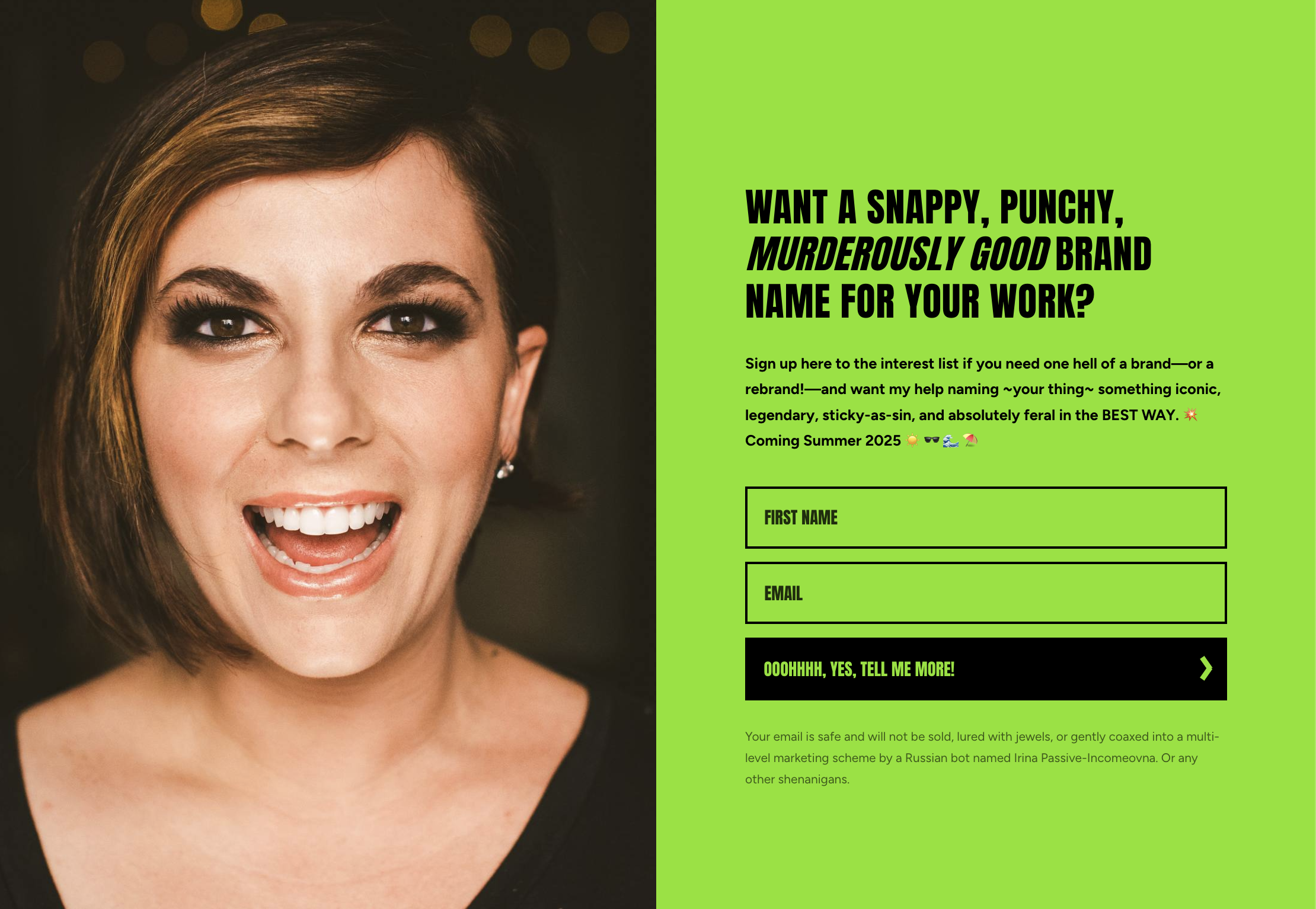
Craving a snappy, punchy, *murderously good* brand name for ~your~ work?
Want that instant recognizability? That instant emotional connection? That instant ability to make people want what you’re selling—all just by naming your brand, your business, your shop, your newsletter, or your course something HELLACIOUSLY FUN & AMAZING?
I specialize in creating irreverent brand names: the kind that slap, sting, pull a knife, and stick in people’s heads like a guilty pleasure.
Names with teeth. Names with tension. Names with a sense of humor.
Names that say, “Oh? What’s that?” and then never let go.
Because here's the truth:
In a world where everyone is named something polite, vague, and algorithm-safe like “Next Chapter Collective” or “ThriveWell Studio,” you need a name that doesn't sound like it was brainstormed over lukewarm tea and a Canva moodboard.
You need a name that makes people feel something immediately—even if that something is mild disbelief, morbid curiosity, or the urge to text it to a friend with six crying emojis.
That’s the power of irreverent naming.
It’s not just funny. It’s friction.
And friction creates memory.
And memory?
Builds a business.
***
Sign up here to the interest list if you need one hell of a brand—or a rebrand!—and want my help naming ~your thing~ something iconic, legendary, sticky-as-sin, and absolutely feral in the BEST WAY. 💥
Coming Summer 2025 ☀️ 🕶️ 🌊 ⛱️
XO,
Ash
ChatGPT gave you the summary.
I give you the rest. Live experiments in remote work, publishing, and AI, from someone who’s been doing this for 17 years. (Still not a newsletter about fish.)
Liked the short answer? The long ones arrive by email.
Do Extraordinary Work. From Anywhere.
I run business experiments in remote work, internet publishing, newsletter growth, and using AI to make your projects pay so well your Stripe notifications start sounding like a slot machine at a Reno bowling alley. This is not a newsletter about fish.
Free. Daily or weekly, you pick.
From the Penguin Random House author seen in The New York Times, The New Yorker, The Guardian and The BBC