Unconventional Career Idea 💡 Start a Paid Newsletter (That Actually Pays)
The paid newsletter.
It’s on everyone’s lips.
Imagine, newsletters becoming hot again? That’s because blogging is becoming hot again. 😍 And, I have a fun theory about this: it’s going to be the Millennials & Gen Xers who dominate this world.
NOT TO GROUP MYSELF INTO AN AWESOME GROUP (except I am totally grouping myself into an awesome group), but we grew up writing on the internet—or just writing in general. Gen Z, on the other hand, grew up making videos on the internet. There is a difference in the way we communicate. And newsletters definitely favor writing.
So, not to get all excited about this or anything, but there is BIG opportunity in running your own newsletter right now.
And, there’s big opportunity in creating paid newsletters right now, too.
LET US EXAMINE THE POSSIBILITIES.
So, I’m going to start this by straight up telling you what I know to be true about running a paid newsletter, having done it various times throughout my writing career:
- If you’re a great writer, people will pay for your writing.
- If you’re a mediocre writer, people will pay for your ideas.
- If you’re a bad writer, people will pay you for your information.
I’ve been spending £10 monthly (~ $13 US dollars) to be a member of The London Times for years now, solely so I can read Caitlin Moran’s weekly column.
She is a great writer.
On the other hand, plenty of newsletters are doing VERY well right now, simply by either sourcing awesome ideas, or sourcing exclusive information.
Rachel Karten, who runs the industry-leading newsletter LINK IN BIO, is a social media advisor whose “five post formats to try right now” is such an excellent spring of fresh ideas—it’s worth the cost of her newsletter alone. (And each newsletter is chock full of analysis of what’s working on social media right now, and what’s not—those ideas are worth money.)
Karten has over 66,000 subscribers.
Lenny Rachitsky writes a newsletter about how big companies build their products and go to market (like how Duolingo reignited user growth and how Figma built their company).
He does not have an inspiring newsletter name. (It’s literally called “Lenny’s Newsletter, which I would never recommend TO LITERALLY ANY ACTUAL HUMAN BEING, so clearly his content is that good). I wouldn’t call him a passionate writer by trade. But the guy has 759,000 subscribers, and his newsletter brings in over $500,000 a year (with his podcast bringing in another $500,000 a year) for a grand total of $1M a year.
He writes one post a week and works on each for 10 to 20 hours.
(Liking this paid newsletter idea now?! Ha!)
Why does this work? It contains specialist information you can’t find anywhere else.
His readers are company founders, product managers, marketers, and start-up nerds. And, Lenny’s creating highly specialized content specifically for them by doing the labor of finding the right contacts and getting the real scoop on how they built the thing they built.
So, once again:
- Great writing = paid subscriptions
- Great ideas = paid subscriptions
- Great information = paid subscriptions
In other words, you don’t have to be a great writer. But if you aren’t, you do have to be a great curator.
And, you also need a paid strategy: what you send out for free vs what you put behind a paywall. EVERYONE is confused about this. But, I have some interesting ideas to share about this, too—including exactly how much you could really earn every month if you do this right.
Want to learn how to start a paid newsletter (that actually pays)?
Upgrade now to access the paid newsletter biz plan. ⬇️
You’ll also get all weekly creative career biz plans—with new plans out every Monday—offering you blueprints for a number of cool, new modern creative career ideas to get the wheels turning, and figure out your next chapter.
New creative career plans are sent out every Monday with a paid subscription. 💪💥
Next Up: The Paid Newsletter (That Actually Pays) Business Plan
Career Title:
Newsletter Publisher
Career Overview:
Create and run a paid online newsletter around a topic you love. (Like horses. Do you like horses?! Then start a newsletter about horses, no joke.)
How It Works:
You launch a free newsletter. Then, a percentage of your readers upgrade to a paid subscription.
Profit Breakdown:
Paid newsletter giant Substack says that between 5% - 10% of free readers become paid readers, with 10% as the number to aim for. (Though 5% is much more common.)
Paid newsletters range in price, and commonly cost between $5/month - $15/month. (Lenny’s Newsletter charges $15/month.)
The more specialist the information, the more you can charge.
So, let’s run through a few models:
SCENARIO ONE
- Number of free subscribers: 5,000
- Number of paid subscribers: 250 (5%)
- Subscription cost: $5/month
- Monthly revenue: $1250/month
However, if we change the percentage of paid subscribers from 5% to 10%, we’re now bringing in $2,500/month.
***So, as you can see, a big part of your paid strategy isn’t always to get more subscribers: it’s to increase your conversion rate.***
What if we also raise the price? What if, instead of charging $5/month, we charge $15/month?
SCENARIO TWO
- Number of free subscribers: 5,000
- Number of paid subscribers: 500 (10%)
- Subscription cost: $15/month
- Monthly revenue: $7,500/month—or, $90,000 a year
Now we can also see: your content strategy is also important, because the better the content, the more you can charge. (And therefore the less subscribers overall you need.)
But, this isn’t bad: 5,000 subscribers is VERY do-able.
As such, you’d be looking at anywhere from $1,250/month to $7,500/month in revenue as you get started. (Depending on the business decisions you make.)
If your newsletter grows, you may be looking at an even healthier scenario.
SCENARIO THREE
- Number of free subscribers: 25,000
- Number of paid subscribers: 2,500 (10%)
- Subscription cost: $15/month
- Monthly revenue: $37,500 (or $450,000 a year - this is close to what Lenny’s Newsletter is doing)
You can run the numbers for anywhere in between, but the best part about running a paid newsletter is that it’s scalable: you do the work once, and thousands of people can access it (and pay you for your work).
Paid Sales Strategy:
This is the biggest key, right here: your sales strategy. What’s going to make this thing sell?
There are a three big factors:
- You need a snappy, tight concept.
- The value needs to be obvious.
- The paid strategy needs to be smart.
Let’s unpack.
First, the snappy, tight concept. There are one million and seven newsletters out there advertising a collection of vague, random topics, e.g. “A newsletter about adulthood, travel, makeup, and dodads I find along the way.” This is too loose. It’s not specific enough. Think about this: how would someone else tell their friend about your newsletter?
You want them to be able to tell people about your newsletter in one clear sentence.
“It’s a newsletter about Gen Z trends.”
“It’s a newsletter about product development.”
“It’s a newsletter about working in social media.”
You need this snappy concept, particularly at first, so random strangers are compelled to subscribe. Even if you’re a good writer, you can’t expect people to find your work and read all your stuff and then make a decision. People are making snap decisions far before that. Time is precious. Even Caitlin Moran’s column could be described as “a newsletter about modern feminism.”
So, you need to get this part right. This is also one of the hardest parts! I’ve found that the harder this is for you, the less clear you are on your topic. It might be worth starting there: what are you really writing about?
Which brings me to the free vs paid strategy.
Commonly, what newbies do is just offer more of the same thing. (Example: one post free per week, one post paid.) This is a tricky strategy, and in my opinion, only works when you’re already known.
Who wants more of the same thing if they don’t even know if they’re gonna like the thing? This is what happens when people advertise their paid benefits as “access to all posts.” When I’m a new reader, this means nothing to me. I don’t want your posts. I want you to tell me the actual benefits of becoming a paid subscriber. What am I getting out of it?
Here’s an awesome example I ran into recently from Jo Thompson’s The Gardening Mind:
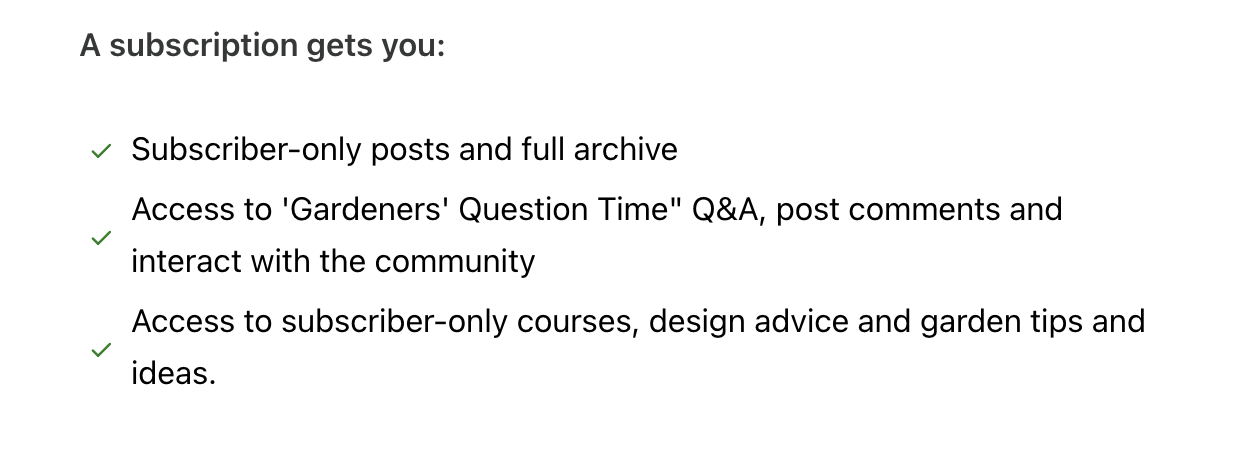
Even though she cites “subscriber-only posts,” she goes on to tell me what the actual benefits are of paying to subscribe.
I was particularly compelled by “subscriber-only courses.”
Less compelled by “post comments and interact with the community” (I hate people, remember).
Here’s what this looks like on her actual subscribe page.
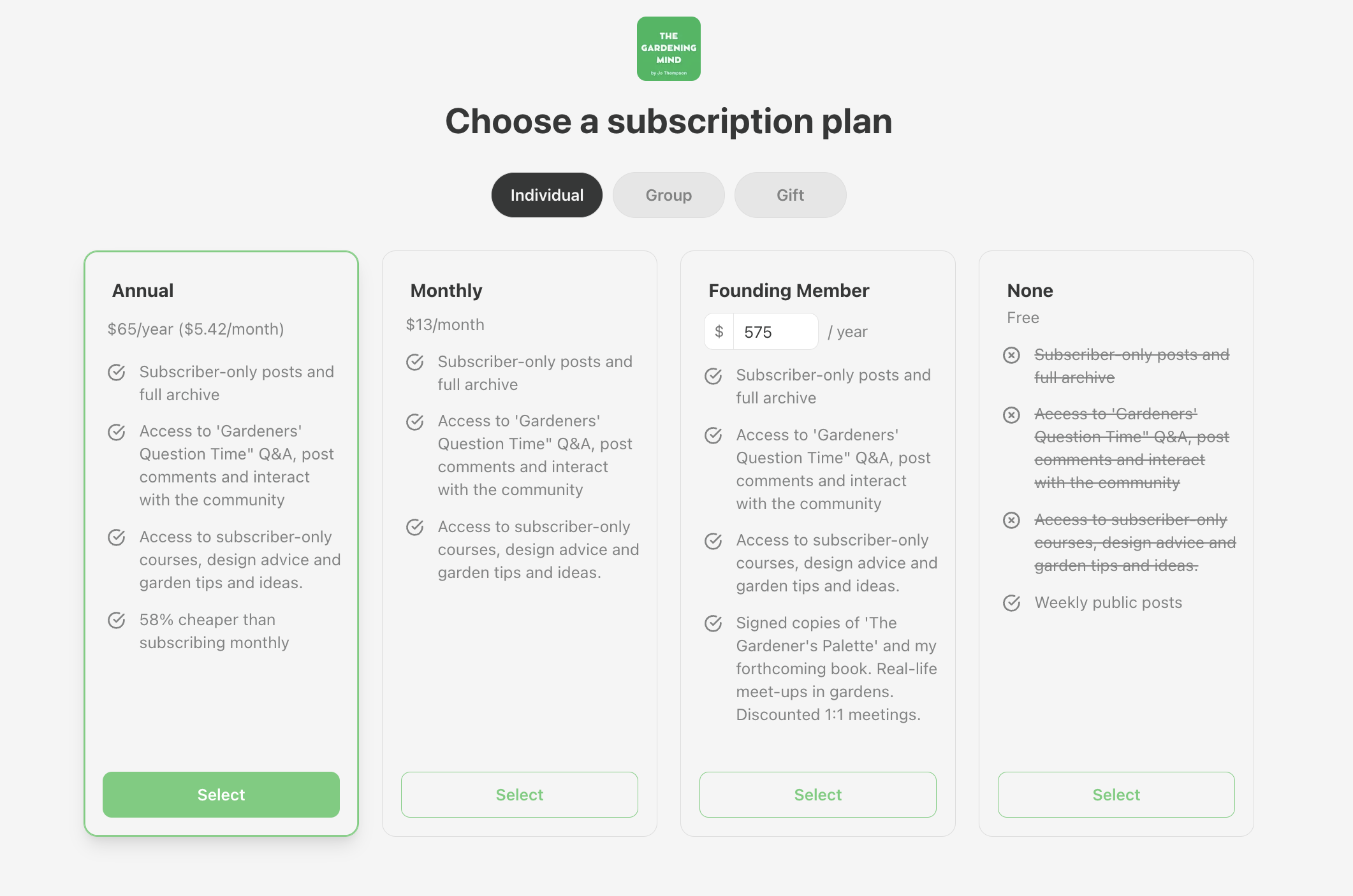
Note! Jo is charging $13/month, or $65/year—which is 58% cheaper than subscribing monthly.
THIS IS A CLEVER STRATEGY.
By making it so obviously more expensive to subscribe monthly, a large percentage of her readers are going to pay the one-time yearly fee, bringing her in more cash flow up front.
We like that.
I approve this strategy!
Also, this is where value comes into play. It’s gotta be obvious value, right up front. This is going to cause you to go bananas thinking about, BUT it’s also such a great exercise.
General rule:
- People don’t pay for posts.
- People pay for the value of posts.
This is where curating ideas and information comes into play.
There is value in Rachel Karten’s “5 Post Formats to Try This Week.” That (a) Gives me good ideas/inspo, (b) Gives me less work to do, and (c) Makes me feel like I could actually have a shot at not looking like an irrelevant bonehead on social. That’s a real benefit. In fact, if she listed that as one of her paid subscriber benefits, I’d 100% upgrade.
Here’s her paid subscriptions now:
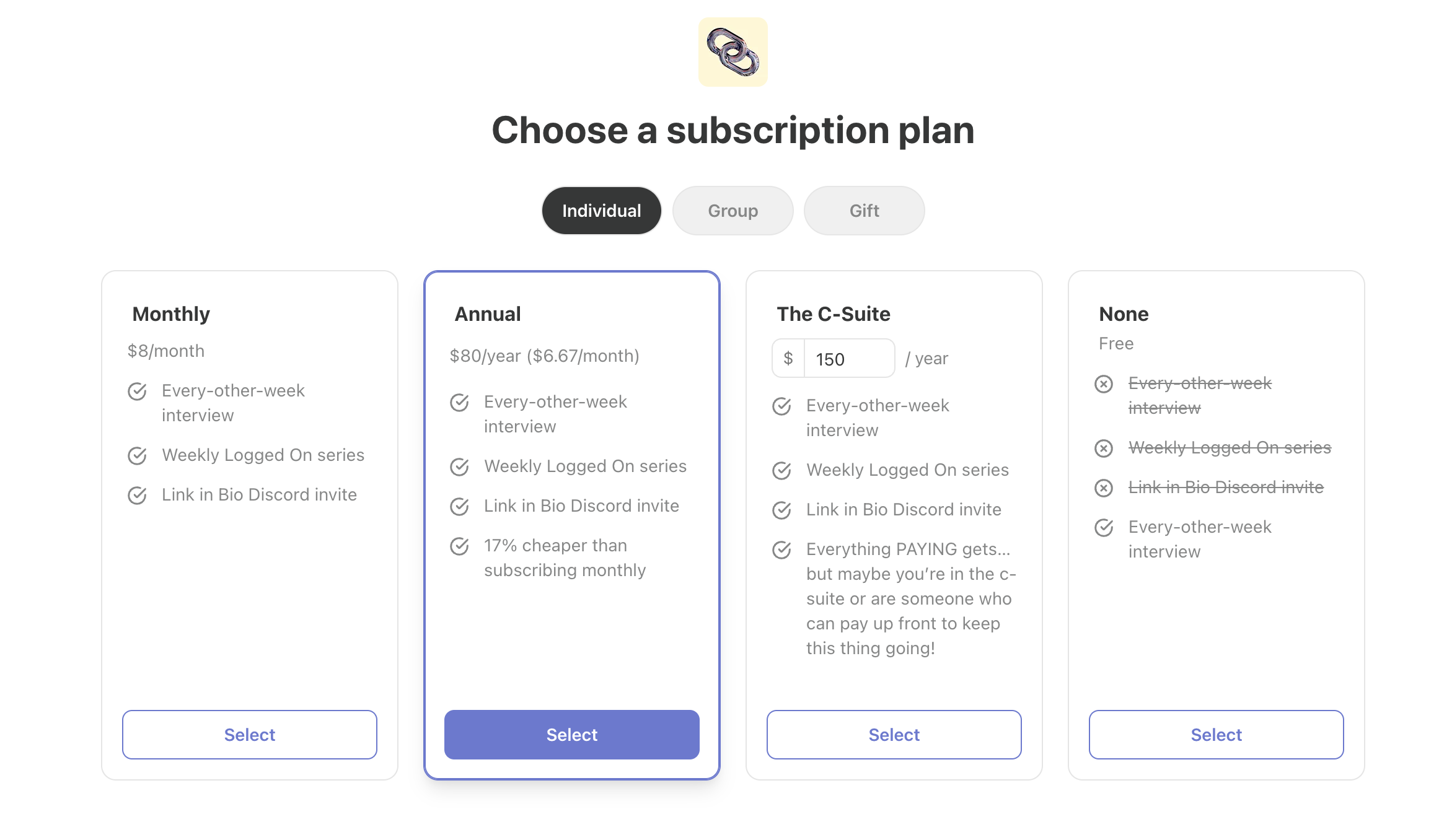
She’s charging $8/month, or $80/year, and paid subscribers get the “weekly Logged On series” and an invite to the private Discord group.
I only know what the Logged On series is, because I am a paid subscriber. (It’s a bonus issue on the weekend.)
However, if I’m being prompted at sign-up to upgrade, I have no clue what that is. A better strategy here would be to be very clear about what they get, i.e. I’ll tell you what to post on social. Or 15 things to try this week on social.
The utility here is actually important. I hate to say this, but in my experience, the most paid subscriptions come from the actually useful posts - not the thoughtful essays.
In fact, my last essay post resulted in 3 new paid subscriptions.
However, my last “Creative Career Idea” post on starting an online fan club resulted in 51 new paid subscriptions.
Part of this, however, is because the paywall goes up on these posts. And THAT brings me to your strategy around upgrades.
Because strangers have no idea who you are yet, when they first subscribe, it’s unlikely they’re going to upgrade to paid. They’re going to “test the waters” first. If, then, they end up loving you? Then maybe they’ll upgrade.
This means that two things are important:
- Consistency - you gotta show up in their inbox 1-2 times per week for them to fall in love with you and remember who you are and get into what you’re doing.
- Sending your paid posts to everybody’s inbox (even free subscribers) - but only showing a teaser. Then, they hit a paywall. (Substack makes this very easy to do.) And, since they’ve now decided your content is great and they love you, they won’t want to miss the post. BEFORE THAT, however, they won’t really care if they miss a post.
I’ve found that the above is far better for conversions, than if you don’t send your paid posts out with the paywall (and then just beg free subscribers to upgrade with some naggy note). We all hate the naggy note. Especially the ones that are weirdly guilt-trippy, like “This is my full time job, please upgrade so I can pay my bills.” (Or whatever weird shit some people say. Do not do that.)
Better: give ‘em an awesome preview to your content, and then insert the paywall right where it gets juicy.
My strategy here is to always make sure free subscribers get something out of it before being hit with a paywall. That way, it’s not an irritation, but an option.
For example, free subscribers get access to The Coolest Creative Careers in the World for 2024. Every Monday, I send out the idea, and talk a little bit about how it would work.
Then, if you want the deep dive, you can upgrade.
So, even if you’re a free subscriber, you’re still getting value. Know what I mean?
Pros of This Remote Career:
The pros of publishing a paid newsletter are numerous:
- You get to do something you love (make sure the topic you’re picking IS one you love!)
- You’ll be seen as an industry leader
- You’ll build an awesome email list full of readers, which gives you independent power over your career
- The creative satisfaction is wild
- Getting to new benchmarks with your # of paid subscribers is super satisfying and fun!
- You’ll make an income from your writing
- Newsletters aren’t going away (and neither are email lists) - it’s a good investment in your future. You can always pivot and take your subscriber list with you.
Cons of This Remote Career:
- Consistency is hard for many people. You’ve gotta commit to showing up on certain days when you have a paid newsletter, not just sending them out willy nilly
- Even if you don’t have any ideas that week, you’ve got to find some and overcome any creative blocks
- Research is part of the gig
- You will absolutely be tempted to want to talk about all sorts of other topics in your newsletter, but it’s best to keep the focus of your newsletter tight (or at least, on theme).
Overall, this is a creative career slam dunk—so long as the positives outweigh the negatives in your world. 🌎
Do you happen to have any experience running a paid newsletter—or know someone who does? Would love to hear any helpful tips in the comments!

ChatGPT gave you the summary.
I give you the rest. Live experiments in remote work, publishing, and AI, from someone who’s been doing this for 17 years. (Still not a newsletter about fish.)
Liked the short answer? The long ones arrive by email.
Do Extraordinary Work. From Anywhere.
I run business experiments in remote work, internet publishing, newsletter growth, and using AI to make your projects pay so well your Stripe notifications start sounding like a slot machine at a Reno bowling alley. This is not a newsletter about fish.
Free. Daily or weekly, you pick.
From the Penguin Random House author seen in The New York Times, The New Yorker, The Guardian and The BBC