'The Quiet Passion': Is This Where Your Purpose Has Been Hiding All Along?
You ever feel like an old, crinkled up plastic grocery bag?
You know, HOLLOW—without any soft pretzels in it? 🥨 (If there are no soft pretzels in your metaphorical grocery bag, well, you should probably have a good, hard look at your life.)
Last week, we talked about The Shallow Hustle, when you’re busy, but the work doesn’t add up to anything greater, and you’re left holding a big, fat existential crisis in your hand. (Like a cigar, but it’s wet and it’s dripping all over your shoes.) But then of course, you’re all like: well, what if I don’t have anything that I DEEPLY CARE ABOUT?
Enter what I call: The Quiet Passion.
I am not referencing a cake, though how good would this one be? Definitely red velvet, definitely layered with something outrageous, like root beer. Honestly, have we ever tried root beer & chocolate? This cannot be bad.
Rather, The Quiet Passion is a new theory I’ve got about work and how people tap into their real passions—rather than all of the fluffy, Hollywood-style ones we all try out when we’re young, only to be disappointed.
What are Hollywood passions? 🎥
Hollywood passions are the ones that are sold to us as THE DREAM (except maybe you’re discovering that it’s not really your dream?????).
- Starting a travel blog (but planning trips stresses you out, and you actually hate airports).
- Opening a café (but you hate early mornings and, um, people).
- Becoming a novelist (but you don’t like writing alone for hours on end).
- Being a fashion designer (but sewing and production logistics bore you to tears).
- Owning a bookstore (but you prefer reading books over running a business).
- Being a YouTuber (but you hate being on camera and editing videos).
- Becoming an artist (but only if you magically wake up good at it without years of practice).
Hollywood passions sound great in theory but don’t hold up when you actually do the work. The Quiet Passion, though—that’s where the real magic gets down with its bad self.
The Quiet Passion is not the loud, showy, look-at-me-I’m-FABULOUS kind of passion: it’s the quiet, invisible one operating behind the scenes without you even knowing it. It’s the real underlying factor behind why you’re attracted to The Hollywood Passion in the first place. (Even if you never would have ever thought of it!)
I am convinced that understanding this is the key to finally finding your Grown Up Purpose™️: all of that meaning and depth and fulfilling satisfaction you’re supposed to have found with your work by now. (But haven’t.)
It’s probably not obvious.
It’s probably not even on your radar, right now.
And, it’s definitely not going to rush right up to you and pull down your pants and go *smack!*.
But, it’s been there all along—woven into the tiny things you keep coming back to, the work you do when no one’s watching, the part of the dream you actually love when the fantasy fades.
Let me tell you how this works and where to find *your* Quiet Passion—and how it might very well change your career trajectory forever. (Especially if you’ve been spinning and spinning and spinning for years.)
The Quiet Passion: The Passion You’ve (Maybe???) Had All Along, Hiding Like a Tiny Newt in Your Shorts 🩳 🤷♀️
For my entire existence on this weird-ass earth, I have been telling everyone and their extended family that my greatest passion in life was travel. Always has, always will be kind of thing. You know, because I’m a REAL ORIGINAL. 🤣 (No, but really, trailer park me in 2004 thought that going to explore the jungles of Central America was an exceptionally exotic move.)
It just made sense: after falling in love with travel, I organized my entire life, and my entire career, around the ability to do so, continually. And, it worked: I have been fortunate to have spent the past sixteen years living this kind of transient, translucent, float-ey lifestyle, weaving myself in and out of realities and cultures and countries and homes around the globe, while still building my professional body of work and creating experiences that mattered to me.
Travel, in my mind, was MY ONE AND ONLY TRUE LOVE. It made me sound adventurous, sophisticated, the kind of person who nonchalantly says things like, Oh, I summered in the Algarve and have strong opinions on croissants. (Hot take: I could honestly leave ‘em!)
But every time I actually tried to write about travel? It felt blank, hollow, superficial. It was like making a beautiful, towering sandwich and then realizing you forgot the meat—technically still a sandwich, but only in a court of law.
Important side note: one time, in Spain, we ordered a “lomito sandwich,” which in Central America would be the equivalent of a Philly cheesesteak. Here is how it came. I have never laughed harder.
(This is cured meat from the leg of an Ibérico pig—a delicacy in Spain—because the pigs are from a special region & only allowed to eat acorns. Poor fuckers.)
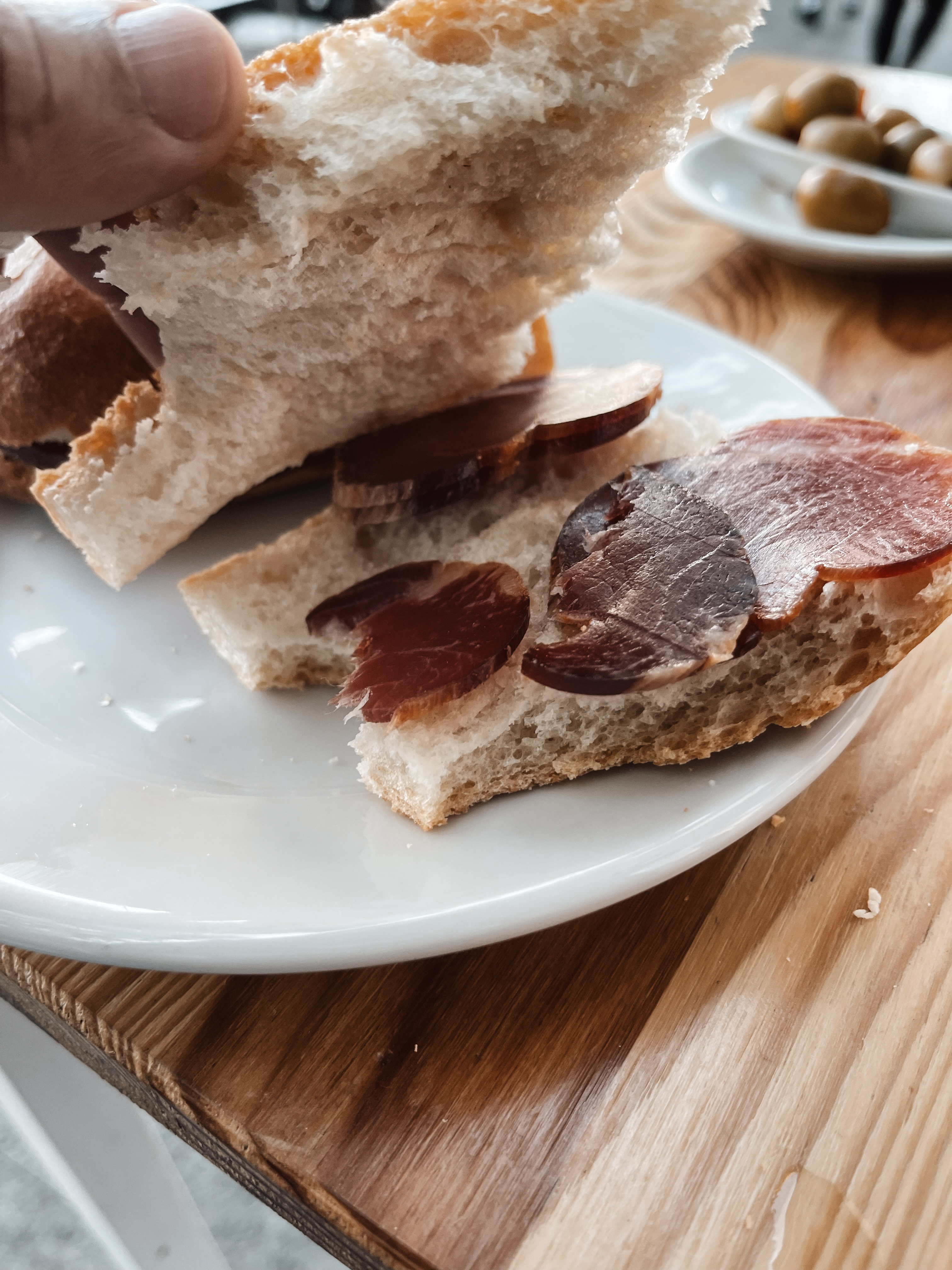
Then again, NOW THAT WE ARE ON THE TOPIC, another time in Spain I ordered some meat, and—to be fair!—this is how it came.
Behold:
Hahahahaha, you win some lose some!
(And this is me ordering as someone with near-native Spanish proficiency. 🤣)
(Speaking of which, is there a world in which you would ever want to take a fun, informal, conversational Spanish language class with me, where you can simply practice? This is entirely left field, but I used to lead adult conversational classes when I did my master’s degree in Linguistics, and I miss it! I like that there is a right answer and a wrong answer with language learning, unlike creative writing, where it’s always subjective. If you’d be interested, add your name here in case I do one. 💃)
ANYWAY—
Turns out, ‘travel’ was how I categorized my passion, but you know what I realized is the truth?
It’s not travel.
Not really.
The more I’ve pricked and prodded and gotten to know myself as an adult? I’ve realized that the real passion lurking underneath is something different.
Architecture & design.
And, not just architecture, but how the built environment makes you feel.
This makes sense, given that:
- I grew up as a trailer park girl, which meant one thing: I was obsessed with housing. I was constantly analyzing the places other people lived, and what it might mean for their lives.
- Eventually, this blossomed into a full-blown romance not just with housing, but with entire towns. I was fascinated by urban aesthetics & townscape design, without yet knowing that was a thing.
- I became an internet writer & creative consultant, and spent all of my twenties and thirties traveling the world. Tough break, I know! But, in doing so, I routinely became exposed to the kinds of places that people loved to live—and flock to. From places like Spain’s San Sebastian, with its charming network of tapas bars, to London, England’s perfectly cohesive city branding & wayfinding, all the way to the coziest towns far down in Patagonia at the tip of South America, one thing became clear: aesthetics mattered. And, America was getting it wrong.
- Every time I would return home, all I could see was stripmalls, stripmalls, stripmalls—and the stark difference between well-designed towns in Europe that prioritize people, rather than cars.
- I would often ask myself how it was possible, in the wealthiest nation on earth, to be so “charm poor.” But, it went further than that: every time I’d return to my teeny tiny hometown in Pennsylvania, the more it had decayed. And, I began to wonder: why? Why are we letting this happen? Why is this getting worse?
- Turns out, the aesthetics of a town aren’t just about looking pretty—they have deep psychological, social, and economic effects that shape how people feel about a place. There’s a well-documented theory that visible neglect breeds more neglect 🏚️—when a town looks rundown (cracked sidewalks, ugly signage, abandoned buildings), people psychologically disengage.
- On the flip side, a well-maintained, visually appealing environment encourages respect. 🌷 A townscape that reflects local history, craftsmanship, and character makes residents feel rooted. When a place has a unique visual identity (charming main street, cohesive signage, historical elements), it fosters a sense of belonging and local pride. If it looks like “just another strip mall town,” people are less likely to form an emotional connection.
In other words, aesthetics are a sales tool.
FASCINATING.
Now, it’s coming together for me.
When I visit a new place, I’m not actually jazzed about the act of travel itself as much as I am how the towns are laid out, how the streets feel, how the buildings communicate shared values (or not), how the public spaces pull people in or push them out. That’s the thing I’ve been drawn to all along. But because nobody tells a kid growing up in rural America that “noticing housing patterns” is a passion, I just assumed I liked the same thing everyone else liked—getting on planes and eating my weight in street food.
And that’s how The Quiet Passion hides. It’s often buried beneath the louder, flashier, more Instagrammable Passion™️ that we think we’re supposed to have. But if you start peeling it back, you’ll see it: the real thing you’ve been obsessed with all along.
How to Find Your Quiet Passion (If It’s Been Hiding from You)
If you’re thinking, Cool, love this theory, but how do I actually figure out my Quiet Passion?, try this:
1. Look at what you naturally nerd out about.
What do you accidentally spend hours researching for fun? What niche topic do you get weirdly enthusiastic about at parties? (Like me, the other day, realizing that THERE ARE ENTIRE COMPANIES WHO DECORATE TOWNS FOR A LIVING. What!!!!!!!!!!!!!)
2. Ask yourself: what part of my "big" passion do I actually enjoy?
You might think you love acting, but is it actually the performance—or do you love analyzing characters? You might think you love baking, but do you really love making cakes, or do you love the science and precision of it?
3. Look at what you've been doing since childhood (even in small ways).
Your Quiet Passion isn’t a new thing—it’s been lurking forever. Were you the kid who rearranged furniture for fun? Who doodled elaborate houses in the margins of your math homework? Who spent hours organizing their CD collection by genre, then mood, then color? (That last one might mean you're secretly obsessed with systems and information architecture, which is absolutely not my forte. 🤣)
4. Pay attention to what you never get tired of.
The Hollywood Passion might excite you briefly, but it burns out fast. Your Quiet Passion? You could do it forever. It’s the thing you return to again and again, without needing external validation, applause, or a dramatic montage sequence. (And, like I said before, if you try writing about the thing, and nothing comes out, maybe it’s not you—maybe it’s the thing. 😀)
5. Notice what makes you irrationally angry.
Weirdly, the things that frustrate us often point to what we care about most. If you lose your mind over decaying Main Streets, cluttered graphic design, or inefficient workflows, there’s a reason. Your Quiet Passion might be hiding in the thing that makes you want to fix the world.
Examples of How This Plays Out
- You think you love fashion—but really, you love composition and aesthetics, which is why you’re drawn to styling, set design, or even curating vintage pieces.
- You think you love starting businesses—but really, you love solving problems and making things more efficient, which is why you’re always tweaking workflows, improving processes, and making lists about making lists.
- You think you love music—but really, you love patterns and structure, which is why you’re also drawn to beat-making, sound design, or even designing killer playlists with absurdly specific vibes. (Which could legitimately be a business.)
- You think you love photography—but really, you love composition and storytelling, which is why you geek out over cinematography, branding, or even home staging.
- You think you love writing—but really, you love the rhythm of language, which is why you’re just as obsessed with naming things, crafting taglines, or editing other people’s work.
See the pattern? Your real passion might not fall into one of the obvious categories—it may actually be the deeper curiosity that fuels it.
When you stop chasing the shiny, loud, capital-P Passion and start looking at what’s been pulling at you all along? Everything might just start to click in a new, unexpected way. That’s when work doesn’t feel so forced. That’s when you stop worrying about whether you’ve found “your thing” because, surprise—you’ve had it this whole time.
It’s just been quietly waiting for you to notice.
P.S. We talked about meat AND pretzels in this newsletter, so I must now leave you with yet another cinemagraphic portrait of excellence:
The box of Philly pretzels I bought for the Superbowl.
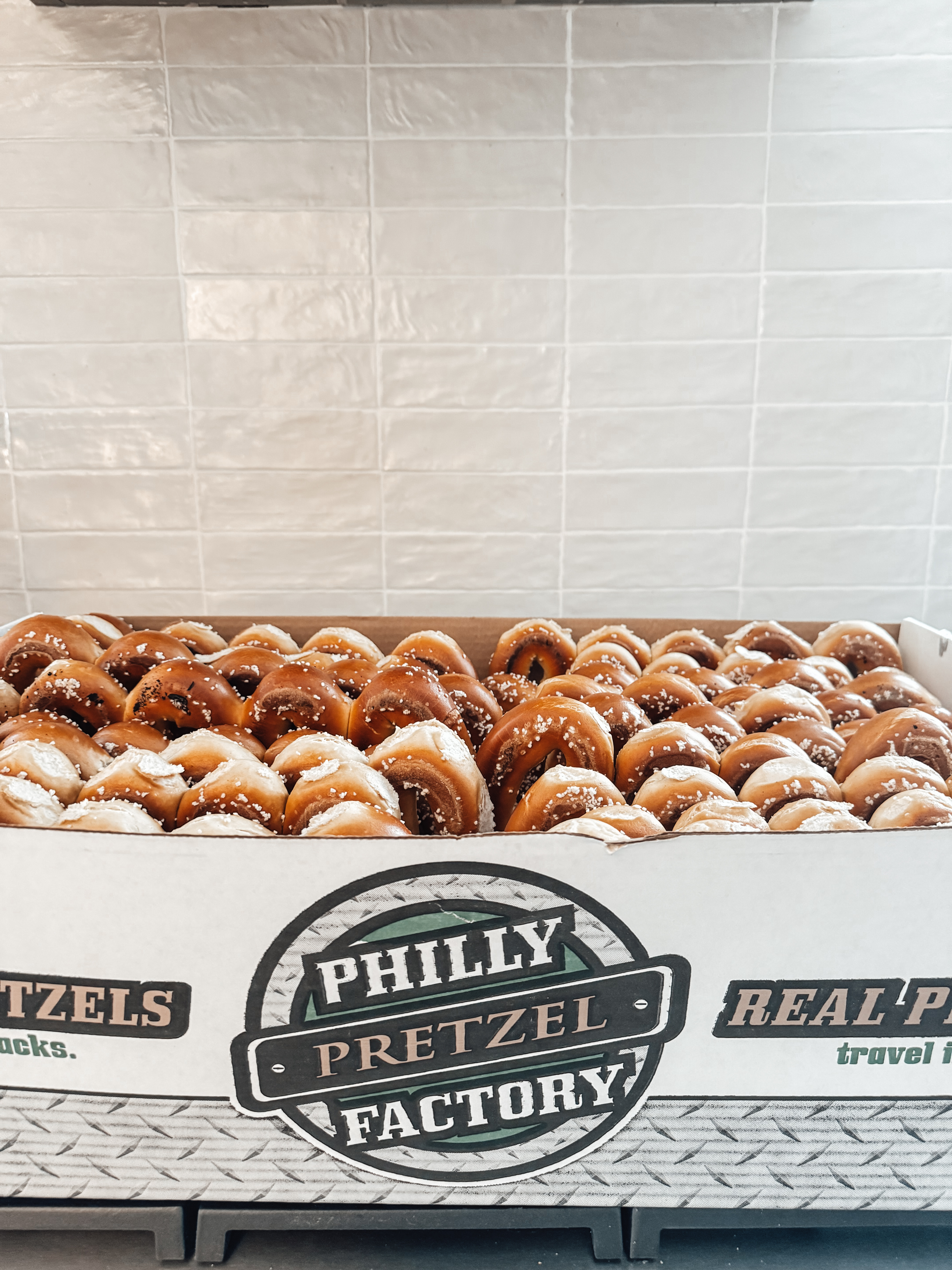
Yes, there are 100 soft pretzels in there.
Step up your game son.
🦅🦅🦅🦅🦅🦅🦅🦅🦅🦅🦅🦅🦅🦅🦅🦅🦅🦅🦅🦅🦅🦅🦅🦅🦅🦅🦅🦅🦅🦅🦅🦅🦅🦅🦅🦅
Share this with someone you know who’s going through a sloppy, weird, anxiety-producing mid-life career crisis (and they don’t even have any freaking pretzels).
ChatGPT gave you the summary.
I give you the rest. Live experiments in remote work, publishing, and AI, from someone who’s been doing this for 17 years. (Still not a newsletter about fish.)
Liked the short answer? The long ones arrive by email.
Do Extraordinary Work. From Anywhere.
I run business experiments in remote work, internet publishing, newsletter growth, and using AI to make your projects pay so well your Stripe notifications start sounding like a slot machine at a Reno bowling alley. This is not a newsletter about fish.
Free. Daily or weekly, you pick.
From the Penguin Random House author seen in The New York Times, The New Yorker, The Guardian and The BBC