Dear World: I Paid $46,887 in Interest in Just Two Years. (Here's What They Don't Tell You About Mortgages.)
I’m Ash, and I’m a writer, traveler, nonconformist & nomad, and every week I’m sharing funny field notes from around the world. Currently, I’m in America writing about what it’s been like to return home to my small town, twenty years after living abroad.
LET ME GET YOU A VOM BAG, YOU ARE GONNA NEED ONE FOR THIS.
There are sickening things—grape jelly, chin hairs, realizing you forgot to empty the crockpot and now it’s full of mold—but none of them could even get in the group chat with with the most sickening thing of all:
Residential. Home. Mortgages.
Do you know how sickening American mortgages are?
We need to have a talk about this, because I don’t think most people have any idea what kind of hot garbage is going on here. Alas, allow me to ruin your life! 🤡
The other day, I got this cute little report from my mortgage company. This shiny cute little report. And it tells me how the market’s doing in my area, whether the value of the farmhouse is up or down, how many chickens are crossing the road.
But then, I scrolled down.
I scrolled down!
And there, in big, red print, like they weren’t even trying to hide it, was a number.
A NUMBER!!!!!!!!!!!!
IT MADE ME SCREAM.
Surely this number was wrong? I’ve heard Flat Earthers who made more sense than this number. This number was a bad, very bad number.
I still shudder to think about it, but I’m going to do the brave thing, and I’m going to—oh god, deep breath—paste a screenshot here. Please hide your kids. Put on sunglasses. Make sure they are polarized.
Are you ready?
Here is the number that drop kicked me in the frontal lobe:
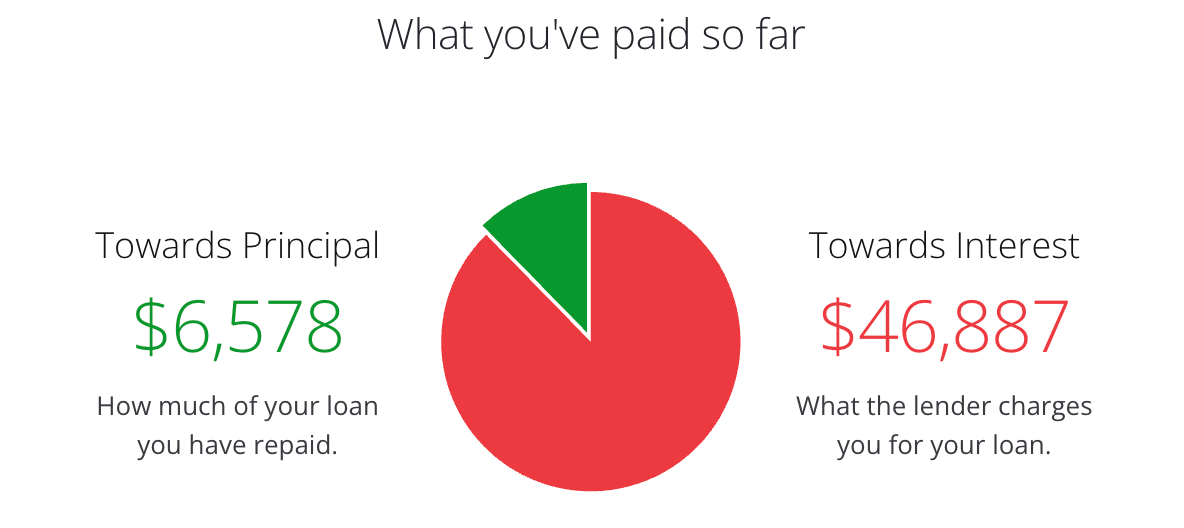
I WILL HOLD WHILE YOU WIPE YOUR MOUTH.
This is to say….
…that in two years…
…I have paid the bank ——$46,887—— in interest 💰….
….and only ——$6,578—— 🦧 toward the principal.
🤯🤯🤯🤯🤯🤯🤯🤯🤯🤯🤯🤯🤯🤯🤯🤯🤯🤯🤯🤯🤯
Ah, yes: how could I forget?
The word no one can pronounce:
AMORTIZATION.
At least, I always want to pronounce it “amor,” like in Spanish—but there’s nothing amorous about it. When I closed on the house, I signed this really neat piece of paper called an “Amortization Schedule.”
On it, it shows you every single payment you will make, and how much of it is interest.
For example, my first payment looked like this on the schedule:

It’s literally telling me that—hey!—the bank is going to charge you ALLLLLLL THE INTEREST UP FRONTTTTTTT, because apparently we are all suckers and the system has been rigged.
And, I knew this going in.
My grand plan was to pay off the house as quickly as possible, because if you don’t?
There is an even more sickening number:

What?????????????
You’re telling me that on a property I bought for $330,000, I’d pay an extra $456,406 in interest? For a grand total of $786,406?
This is, frankly, criminal.
BUT ALSO, most of us humans don’t have a spare $330K to pay cash for their house. Which is why mortgage companies exist. And boy, do they own our asses.
So I started doing some research about the best way to get this paid off smartly (so I don’t have to start sleeping in a paper bag).
Here’s the best way to get your dignity back:
The Amortization Revenge Plan™: Mortgage Life Hacks to Beat the Bank at Its Own Sadist Math Game
Every 1% drop in your mortgage rate saves ≈ thirty grand per hundred thousand borrowed. 💸 The math ain’t small potatoes. 🥔
So in my case, if I were to refinance:Loan ≈ $300K
Rate drop: from 7.25% → 6.25% (1%)
Savings = $90K in lifetime interest.
Rate drop: to 5.25% (2%)
Savings = $180K.
Caveat? You basically have to go through the whollleeeee mortgage process again, which can be a bureaucratic clown car on fire for the self-employed. It’s basically your original mortgage application again — tax returns, pay stubs, the whole “prove-you-exist” parade. They’ll verify your income, debts, and credit (and make you send over 999 bank statements from the last 103 years). Then, you’ll have to have the house re-appraised (costs around $400–$700), and pay a refinancing fee, which all together? You’re looking at roughly $6,000–$15,000 on a $300K refi. JUST TO REFINANCE IT, FRIENDS. What??????????????
How to know if it’s worth it? I asked our pal ChatGPT to analyze. Chatty tells me that our break-even point =
(Closing costs) ÷ (Monthly savings). If you pay $8,000 to refinance and save $400/month, your break-even is 20 months. If you’ll stay in the house longer than that, it’s worth doing.
But, like????? Still. I repeat: WHAT????????????????????????? I hate that this is the process. Not appealing. Don’t want to do it. I’d rather work extra weirdly hard to make an extra $100K and throw it down on the principal and be like “WHAT UP, BANK?! WHAT NOW!” Go team entrepreneurship, because what a luxury to even be able to think like that.
Every $100 extra you pay per month? Saves roughly $30,000 in interest. 🖕🏻
This seems do-able.
So obviously I GOT ALL HOT AND BOTHERED and wanted to run the numbers on what would happen, just for kicks, if I went balls to the wall and doubled my mortgage payment—and put another $2,318.88 per month toward only the principal.
The outcome????
I’d save $365,740 in interest. 😱😱😱😱😱😱😱😱😱😱😱
And have it paid off in 7.3 years (instead of 30!)
BUT STILL! Would still pay the bank $90,666 in interest. Because of how they front-load it. Isn’t that actually, verifiably brain-melting??????????? It still seems like I’d be better off starting a new company real quick to bring in an extra $300K and just PAY IT OFF. I mean???????????? Honestly, that sounds crazy, but is it crazier than paying these fees? I don’t think it is. I think we all need to start hyper-profitable internet companies that let us do what we want and buy houses in cash and then do it again in Scotland next year. WHO’S IN??????
Switch to biweekly payments and you’ll make one extra payment per year (without feeling it!) — cutting 4–5 years off your loan and saving roughly $70,000 in interest.
Okay, that’s interesting. Also seems relatively do-able. And little chunks are easier for entrepreneurs with cash flow ~~~stuff~~~.
Most lenders let you do bi-weekly payments.
And, it’s not as much of a hit on your bank account the 1st of every month. 🔨
APPARENTLYYYY, if you have a lump sum to offer to the mortgage gods? Like $10K+? You can plop it down on the balance and the lender will often lower your monthly payment without the hassle of refinancing.
It’s called “recasting.”
This seems like a good hack, if you come across the extra moo moo.
Seriously: who knew that mortgages cost so much?
You hear about these cute little interest rates—down to 5%!—and you’re like, oh wow, that’s so much cheaper than credit cards!!! Somebody gimmie a balloon arch!
But if the math were that simple—like a lot of people might interpret—you might imagine that the bank is just charging you 5% on $300,000.
Which would only be $15,000! (And much more humane.)
But nope. That’s not how mortgages work.
If the bank just charged you 5% of $300,000, that’d be $15,000 and we could all go home happy. But mortgages are like the Las Vegas buffet of finance — they charge you a little bit of interest on the full balance every single month, and then they do it again the next month, and again, and again, while your actual balance barely budges.
It’s not 5% total. It’s 5% a year, recalculated every thirty seconds based on how much you still owe. And since you owe almost the whole thing in the beginning, your “cute little 5%” ends up looking more like “half your paycheck, forever.”
The system’s designed so the bank gets paid first, and you—well, you eventually get arthritis.
That’s the dark art of amortization — which sounds like a spell Harry Potter would use to make your money disappear, and honestly, same vibe.
Amortization means your payment stays the same every month, but the way it’s divvied up changes over time. In the beginning, almost the entire thing goes to interest—aka “bank champagne fund”—and only a few sad dollars go toward the actual house.
Over time, as your balance shrinks (and your will to live stabilizes), more of that same payment starts going toward your principal. Eventually, you’re paying down real debt instead of just paying rent to Wells Fargo. But those first few years?
You don’t own the house yet. The bank just lets you dust it.
So! I thought I’d send over this light-hearted news so we could all really kick off the week with a great start.
Don’t you feel better?
Me, too.
If anyone needs me, I’ll be in the woods with a calculator, a bottle of wine, and my emotional support vom bag.
Tune in next week when I tackle health insurance!
Just kidding. I’m not that cruel.
ChatGPT gave you the summary.
I give you the rest. Live experiments in remote work, publishing, and AI, from someone who’s been doing this for 17 years. (Still not a newsletter about fish.)
Liked the short answer? The long ones arrive by email.
Do Extraordinary Work. From Anywhere.
I run business experiments in remote work, internet publishing, newsletter growth, and using AI to make your projects pay so well your Stripe notifications start sounding like a slot machine at a Reno bowling alley. This is not a newsletter about fish.
Free. Daily or weekly, you pick.
From the Penguin Random House author seen in The New York Times, The New Yorker, The Guardian and The BBC